Every commercial vehicle on the road is a potential hazard if not properly maintained. A tyre blowout at 70 mph, a brake failure on a steep grade, or a lighting fault that makes a trailer invisible to following traffic — these are not rare edge cases. They are documented, recurring causes of crashes that injure and kill thousands of road users every year.
Vehicle inspection is the systematic practice that prevents these outcomes. For commercial drivers, it is also a legal requirement. For professional training schools, it is a core component of the curriculum. And for any driver who takes their responsibilities seriously, it is simply the right thing to do.
The Legal Framework: What Federal Law Requires
The Federal Motor Carrier Safety Administration (FMCSA) establishes mandatory inspection requirements for all commercial motor vehicles (CMVs) under 49 CFR Part 396. Key provisions include:
- Pre-trip inspection (396.13): Drivers must satisfy themselves that the vehicle is in safe operating condition before every trip, reviewing the previous driver vehicle inspection report (DVIR)
- Post-trip inspection (396.11): Drivers must complete a written DVIR at the end of every day of operation, reporting any defects or deficiencies
- Periodic inspections (396.17): Every CMV must be inspected at least once every 12 months by a qualified inspector to a standard defined by federal regulation
- Roadside inspections: Commercial vehicles are subject to inspection by CVSA-certified inspectors at any point. Vehicles that fail an inspection may be placed out of service until defects are corrected
In 2023, the CVSA's Operation Safe Driver Week and roadside inspection blitzes resulted in more than 15,000 out-of-service orders for vehicle defects — defects that could have caused crashes if not caught. Every one of those vehicles had been operated by a driver who either did not inspect properly, or did not act on what they found.
What a Professional Pre-Trip Inspection Covers
A compliant, thorough pre-trip inspection follows a systematic walk-around of the vehicle. Drivers should approach this with the same discipline as a pilot's pre-flight checklist. The following areas must be inspected:
Engine Compartment
- Engine oil level and condition
- Coolant level and hoses for leaks or cracks
- Power steering fluid
- Windshield washer fluid
- Belts for fraying, looseness, or glazing
- Battery terminals and fluid (where accessible)
Cab and Controls
- Horn (both city and air, where applicable)
- Windshield and mirrors — no cracks larger than allowable limits, properly adjusted
- Wipers and washers functional
- Gauges and warning lights — all operational, no warning lights active
- Seatbelt condition and retractor function
- Emergency equipment: fire extinguisher, warning triangles, first aid kit
Braking System
Brake failure is one of the most catastrophic mechanical events a driver can experience. Inspection must include:
- Air pressure build-up rate (should reach 90 psi within 3 minutes at operating RPM)
- Low pressure warning alarm activates above 60 psi
- Brake pedal feel and travel (not spongy, not low)
- Parking brake holds vehicle on a grade
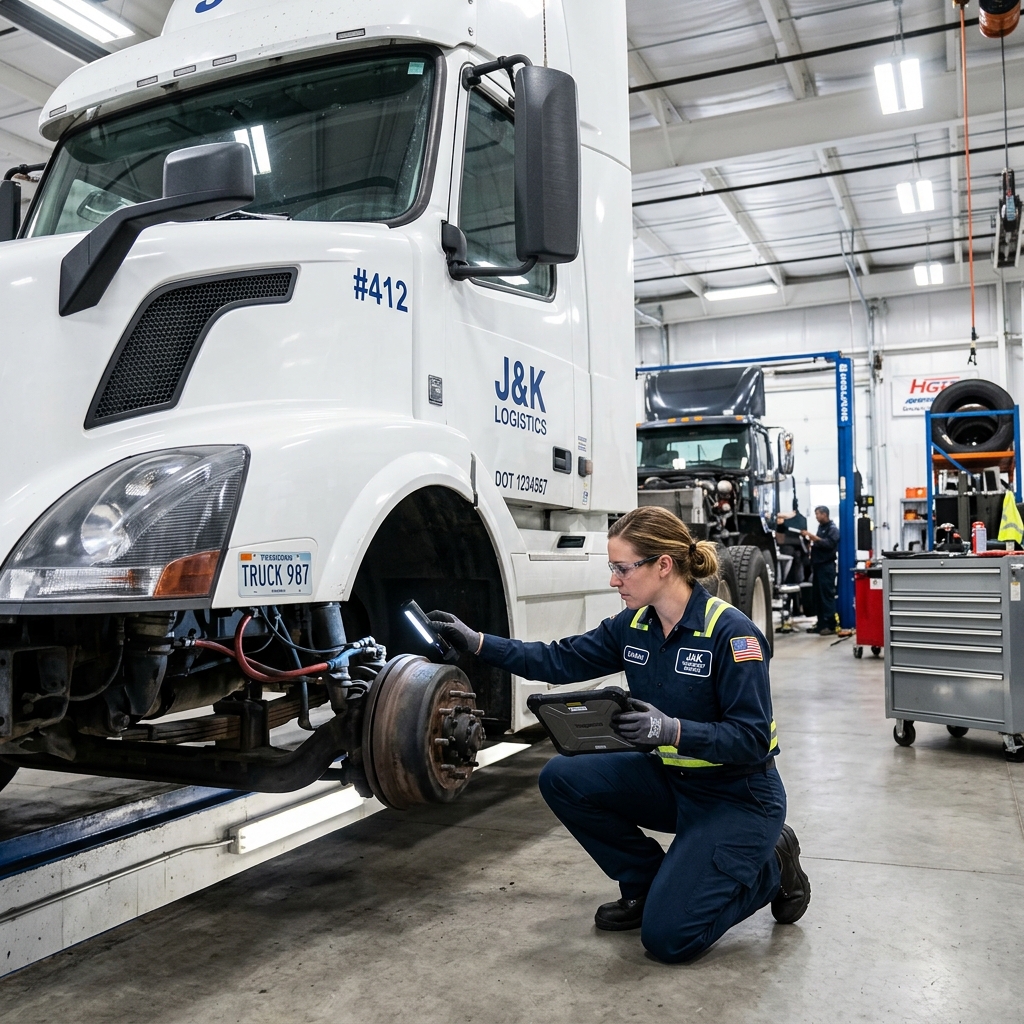
- Visible brake components: drums/rotors for heat cracks, linings for wear, hoses for abrasion
- For combination vehicles: trailer brake supply and control lines inspected for security and condition
Tyres and Wheels
- Tread depth: minimum 4/32" on steering axle tyres; minimum 2/32" on all other tyres
- Tyre pressure checked with calibrated gauge
- No sidewall cuts, bubbles, or exposed cord
- No mismatched tyre sizes on same axle
- All lug nuts/bolts present, showing no signs of movement (rust trails, shine marks)
- Hub seals with no oil leaks
Lights and Signals
- All headlights (low and high beam)
- Brake lights and reverse lights
- Turn signals front and rear
- Hazard flashers
- Clearance, identification, and marker lights
- Reflectors clean and undamaged
Why Drivers Skip Inspections — And Why That's Dangerous
The most common reasons drivers fail to conduct thorough pre-trip inspections are time pressure, fatigue, and familiarity bias ("I drove this truck yesterday, it was fine"). All three are understandable — and all three are professionally unacceptable.
A component can fail overnight. A tyre can lose pressure in a trailer sitting in the yard. A brake adjustment can change during the previous day's operation. The inspection exists precisely because conditions change between trips.
Inspection as Part of Training Excellence
The CTSDA accreditation standard requires that all accredited commercial driver training schools include systematic, practical vehicle inspection training as a core curriculum component — not an afterthought. Schools must demonstrate that students can conduct a thorough pre-trip and post-trip inspection to FMCSA standards before graduation.
This commitment to inspection training is one of the measurable differentiators between CTSDA-accredited schools and those operating without independent quality assurance. When employers hire graduates of CTSDA-accredited schools, they can be confident that inspection habits have been properly instilled.
Building a Culture of Inspection Excellence
The best fleets do not treat vehicle inspection as a compliance exercise — they treat it as a professional ethic. Safety-conscious carriers create systems that:
- Allocate sufficient time in dispatch schedules for proper pre-trip inspection
- Reward and recognise drivers who identify and report defects
- Never pressure drivers to operate vehicles with known defects
- Maintain clear, rapid defect resolution processes so drivers are not waiting days for repairs
- Conduct annual refresher training on inspection procedures for experienced drivers
Conclusion
Vehicle inspection is not an administrative burden — it is a professional practice that saves lives. The difference between a driver who walks around their vehicle every morning with genuine attention and one who signs a form without looking is, at some point, the difference between going home and not going home.
If you represent a training organisation that is serious about inspection culture and professional standards, we invite you to learn more about CTSDA accreditation and the difference independent verification makes.